
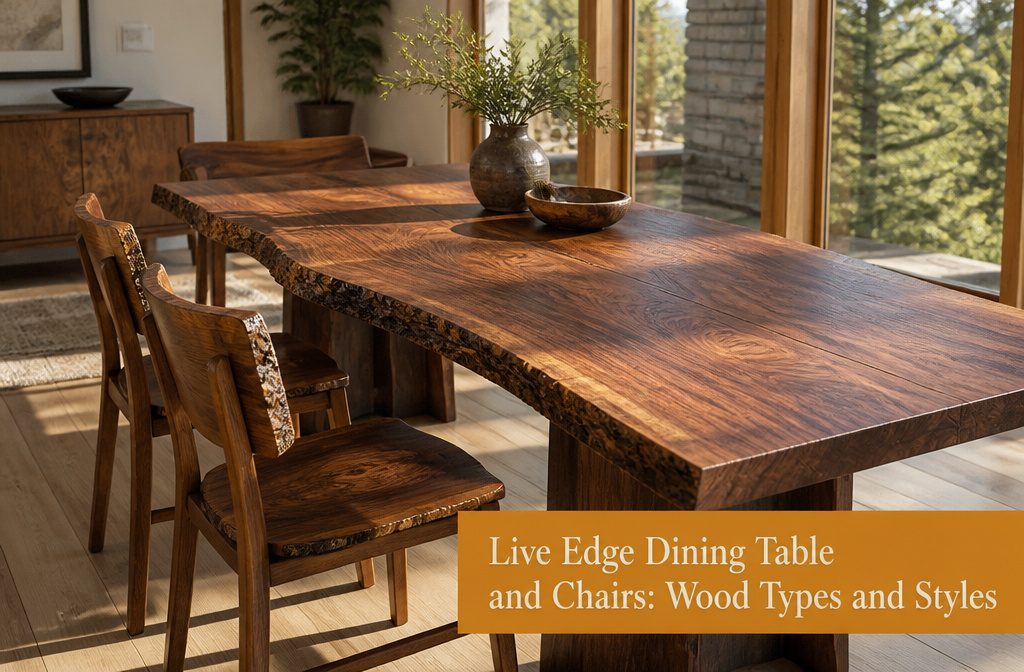
A live edge dining table and chairs set pairs a slab-top table that keeps the tree’s natural, uncut perimeter with seating that complements the organic edge.
The cost climbs higher than traditional dining sets because each slab is one-of-a-kind, and craftsmen can’t mass-produce irregular wood contours.
Walnut shows up in live edge work more than almost any other hardwood, prized for its deep chocolate-brown grain and durability under daily use.
What a Live Edge Dining Table Is
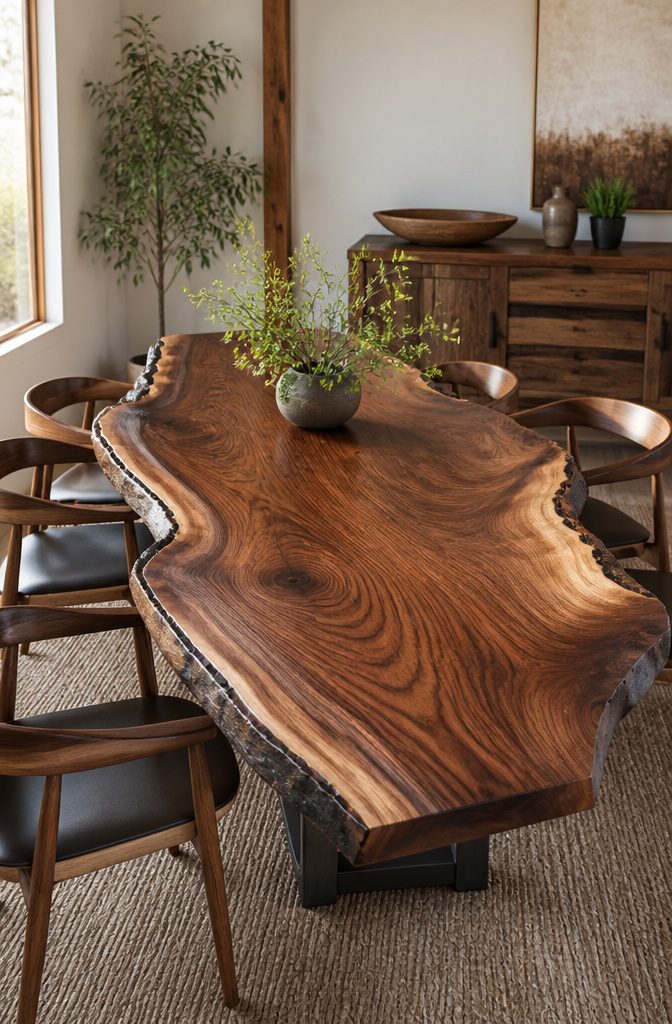
A live edge dining table keeps the natural, uncut edge of the tree rather than trimming the slab into a symmetrical rectangle.
Craftsmen preserve the raw contour that the trunk grew with, so the table edge follows bark line and burl the way it formed in the forest. The top is flattened for function, but the perimeter stays organic.
Hardwood slabs are the starting point: walnut, oak, maple and acacia are common choices.
Because each tree grew differently, no two tables match. One walnut slab might taper toward one end, another flares wide in the middle, a third carries a knot cluster that becomes the focal point of the finished piece.
The look works in rustic interiors and contemporary ones alike.
A live edge table brings texture and irregularity into a room that would otherwise read as too controlled, and that makes it popular with people who want something handcrafted rather than mass-produced.
1. Walnut
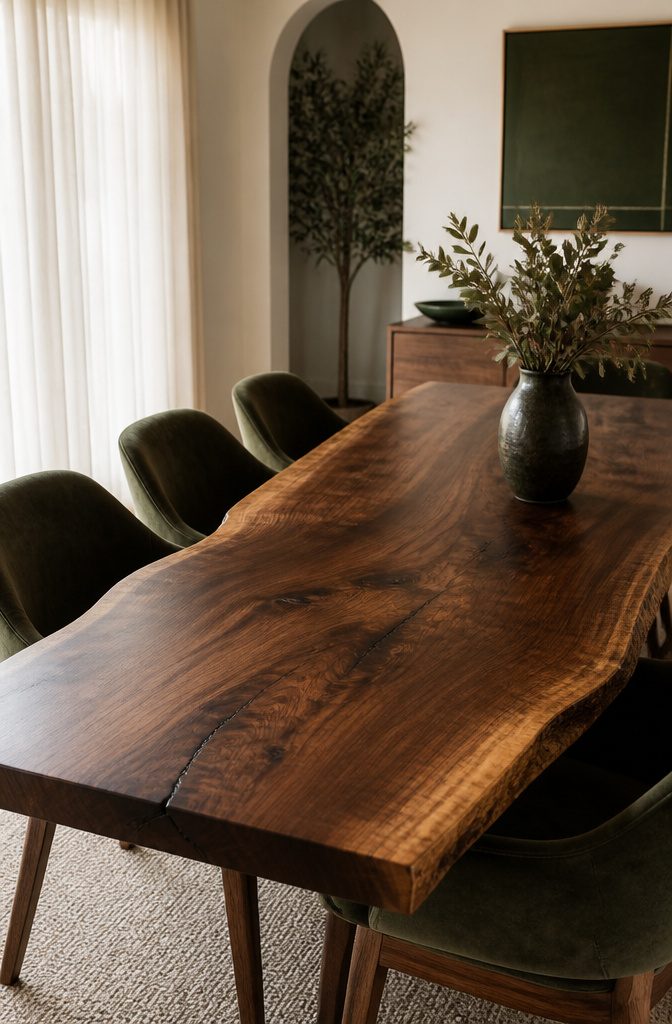
Walnut shows up in live edge work more than almost any other hardwood, and the reason is visible the moment you stand next to one: deep chocolate-brown grain with irregular dark streaks that catch light differently depending on the angle.
The color alone reads as luxury, and it pairs especially well with the rough, natural edge that defines this style of table. Where lighter woods can look unfinished or too rustic, walnut balances the raw edge with richness.
Durability is rated very high, so a walnut live edge dining table holds up to daily use without needing constant attention.
The wood resists dents better than softer species, and the surface develops a subtle patina over time rather than showing wear as damage.
Owners on Reddit mention pairing walnut tables with deep green or jewel-tone chairs to pull out the warm undertones in the grain, and that combination tends to work because the wood itself has enough presence to anchor a room without competing with bold colors.
2. Oak
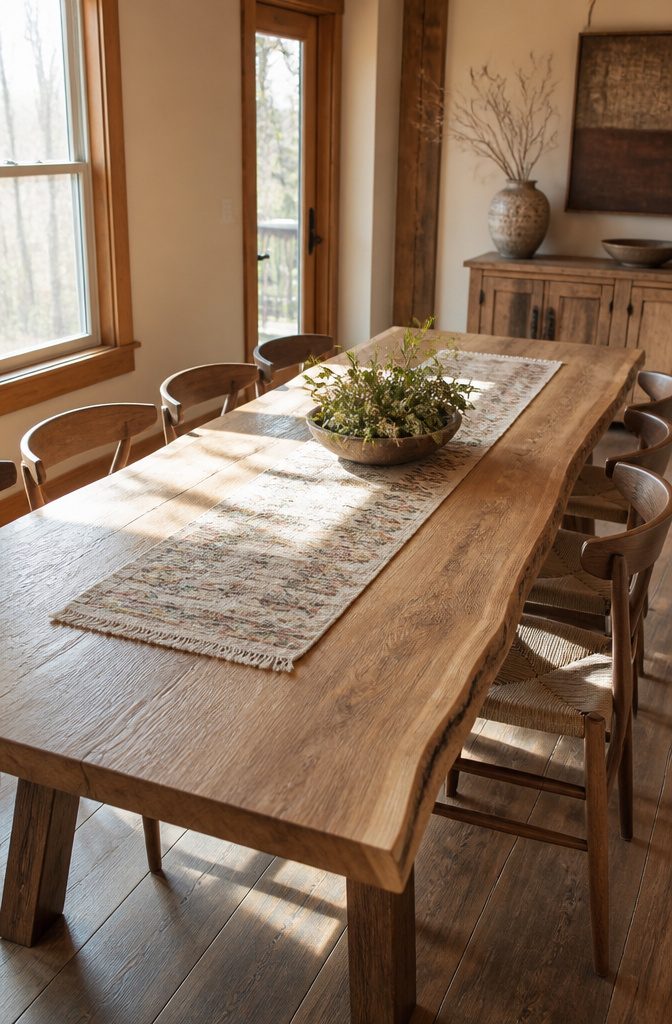
Oak shows up with wide, open grain that you can see from across the room.
The pattern runs in long, bold arcs across the surface, and when you leave the natural edge on a slab, those grain lines reach all the way out to the bark line without interruption.
The look reads traditional or rustic depending on what you pair it with, and the durability rating sits high enough that the table holds up to daily use without babying it.
The color runs light to medium brown, so it works in spaces where walnut or acacia would look too dark.
I tend to reach for oak when someone wants the live edge character but needs the wood to stay neutral in tone.
The grain adds enough visual interest on its own that you don’t need resin fills or heavy finish work to make the piece feel complete.
3. Maple
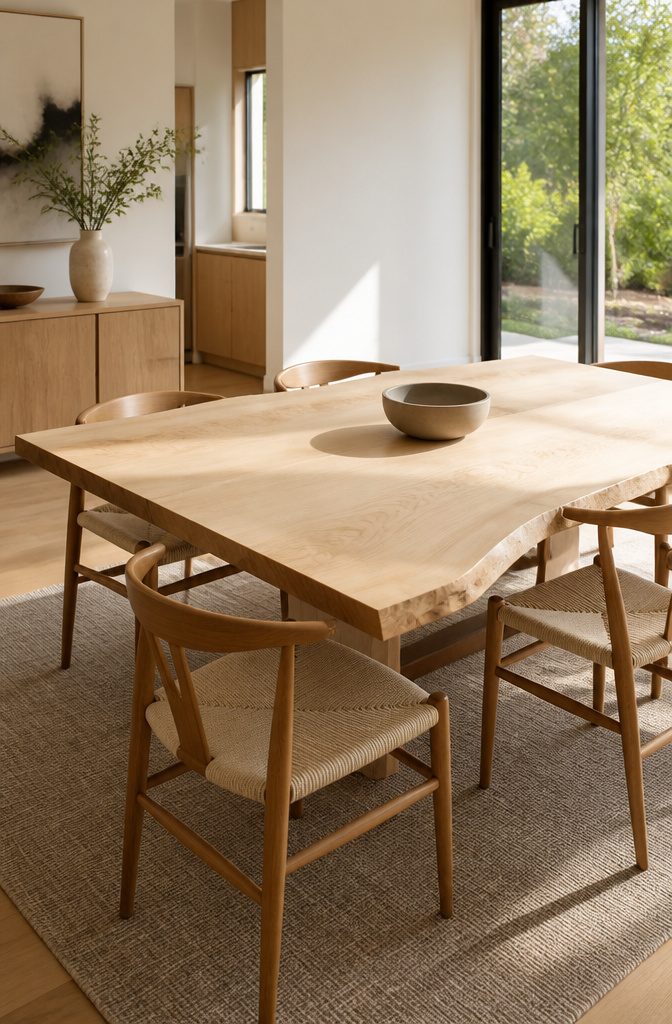
Maple gives you a smooth, pale surface with subtle grain that reads clean and contemporary rather than rustic.
The wood itself is creamy white, which means it opens up a room instead of anchoring it the way walnut or cherry does. Durability sits at high, so the table can handle daily use without showing wear quickly.
The pale tone makes maple a natural fit for lighter, more minimalist spaces where darker woods would feel too heavy.
If you’ve been looking at walnut or acacia and the room feels like it needs breathing room, maple offers the contrast without losing the live edge character.
The grain stays understated, so the organic edge line does most of the visual work rather than competing with bold wood figuring.
4. Acacia
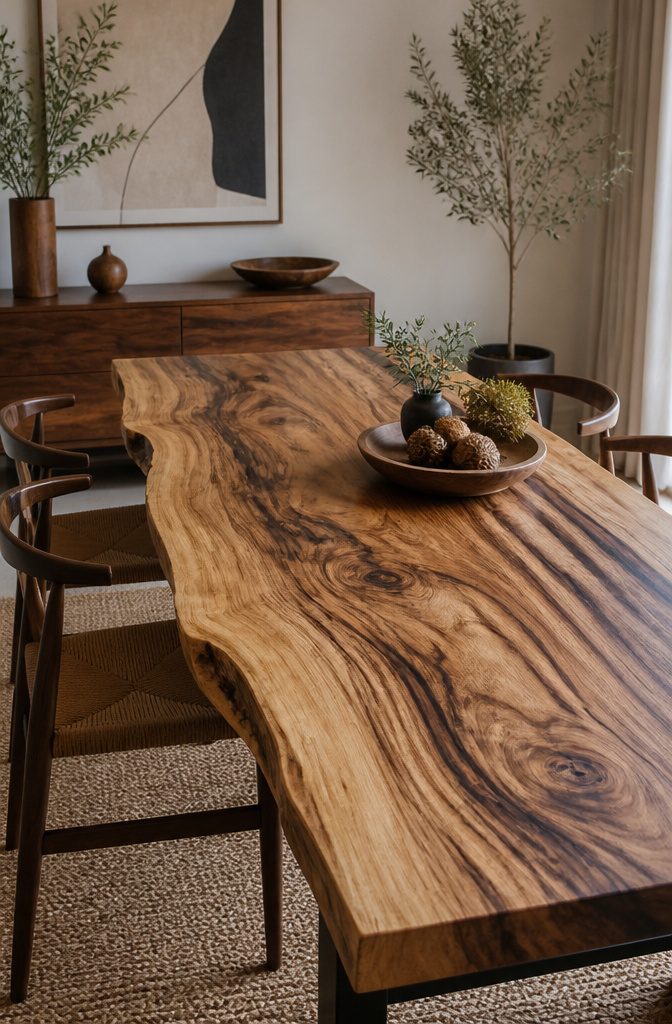
Acacia brings warm golden tones layered with darker chocolate and espresso striations that shift as the grain moves across the slab.
The contrast comes from the wood itself rather than from stain, and no two pieces land on the same balance of light and amber.
A live edge acacia table reads warmer than walnut but more dramatic than oak, and the natural variation means the piece holds visual interest without needing resin inlays or heavy finish work.
Durability sits between oak and cherry. Acacia holds up well under daily use, resists denting better than softer hardwoods, and tolerates humid climates without warping as readily as maple.
I’d trust it in a household with kids or regular dinner parties, though you still want coasters and trivets the way you would with any unsealed or lightly finished surface.
The grain itself is coarse and open, so live edge slabs show off the full texture of the wood rather than smoothing it into something polished.
That openness also means the finish matters: an oil or wax finish keeps the color rich and lets you see the depth in the striations, while a thick polyurethane can flatten the contrast.
5. Cherry
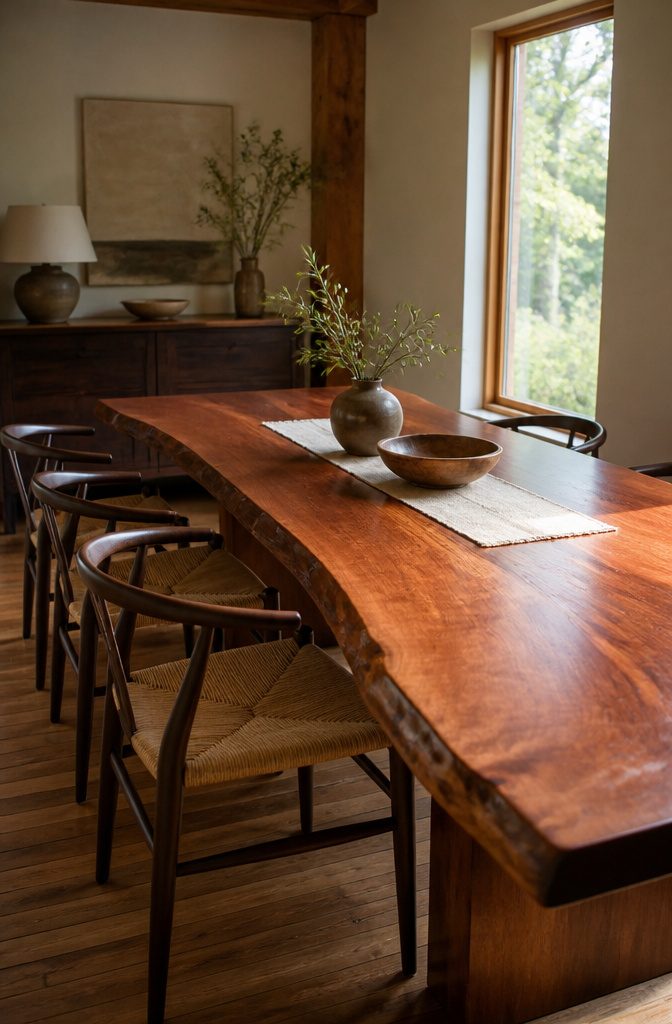
Cherry runs smooth to the touch and holds up to daily use without wearing through too quickly. The durability rating sits at high, meaning it can take years of chair scrapes and dinner service without needing refinishing work every season.
What sets cherry apart is the aging process.
The wood arrives in a reddish brown tone, and over time it deepens into something richer. Sunlight drives the change, so a table placed near a window will darken faster than one kept in a dim corner.
The shift happens gradually, and the patina that develops looks better than the day-one color. If you want furniture that improves as it ages rather than fades or wears out, cherry delivers on that without any work from you.
6. Raw Edge and Smoothed Edge Styles
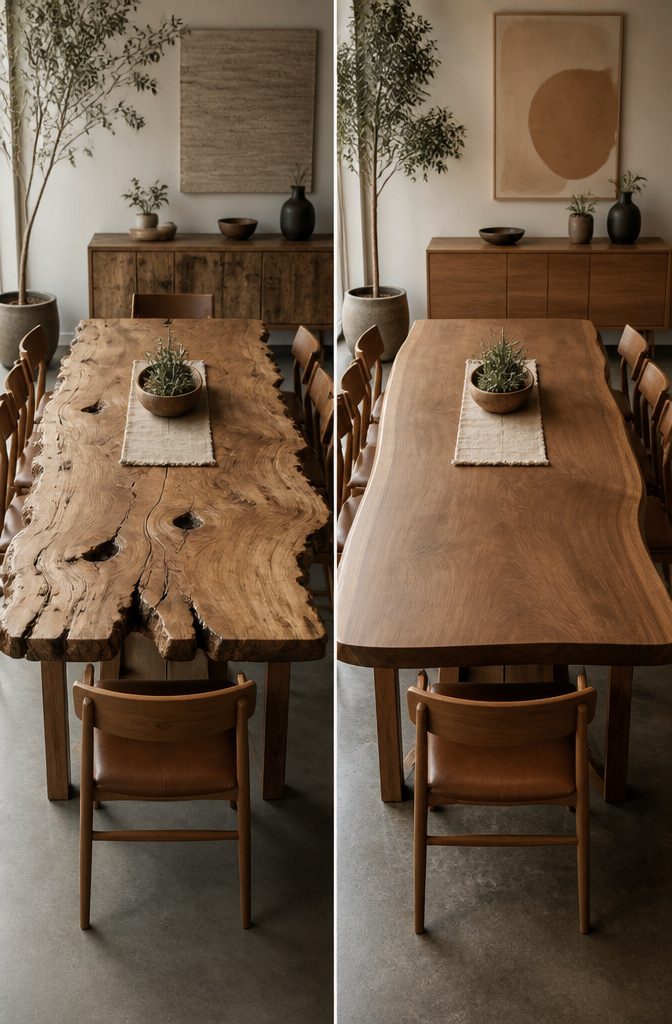
Raw edge means the slab comes off the saw with bark, knots and irregular contours still visible, exactly as the tree grew it.
You get maximum texture and an unmistakably organic silhouette, but the surface can catch crumbs and snag sleeves if the bark is loose or the edge is sharp.
Raw edge works best in casual spaces where a little roughness feels intentional and you don’t mind extra cleanup.
Smoothed edge takes the same natural contour but sands it down enough to remove splinters and loose bark while keeping the original curve intact. The profile stays uneven, but you can run your hand along it without catching on anything.
This version fits formal dining rooms more easily because it reads as finished rather than salvaged, and it pairs better with upholstered chairs that might brush the table edge during seating.
7. Natural Finish
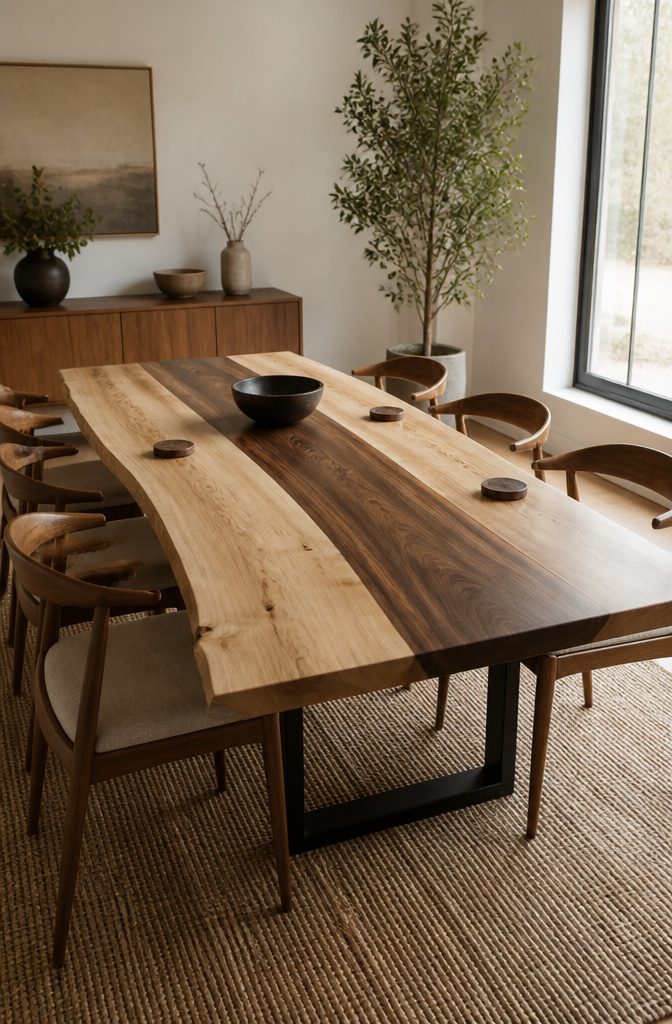
Natural oil finishes let the wood keep its actual color and grain pattern without adding stain or artificial tint.
You see exactly what the tree gave you: the pale cream of maple, the chocolate tones in walnut, the russet glow in cherry.
The oil soaks into the surface rather than sitting on top as a film, which keeps the texture open enough that you can still feel the grain when you run your hand across it.
The finish still protects the table. Oil fills the pores and hardens inside the wood, blocking moisture from soaking in and preventing stains from setting as easily.
It won’t stop a glass of water left overnight, but it buys you enough time to wipe up a spill before it leaves a mark.
The trade-off is maintenance: you’ll need to reapply oil once or twice a year to keep that protection active, especially on a dining surface that sees daily use.
8. Resin Fill
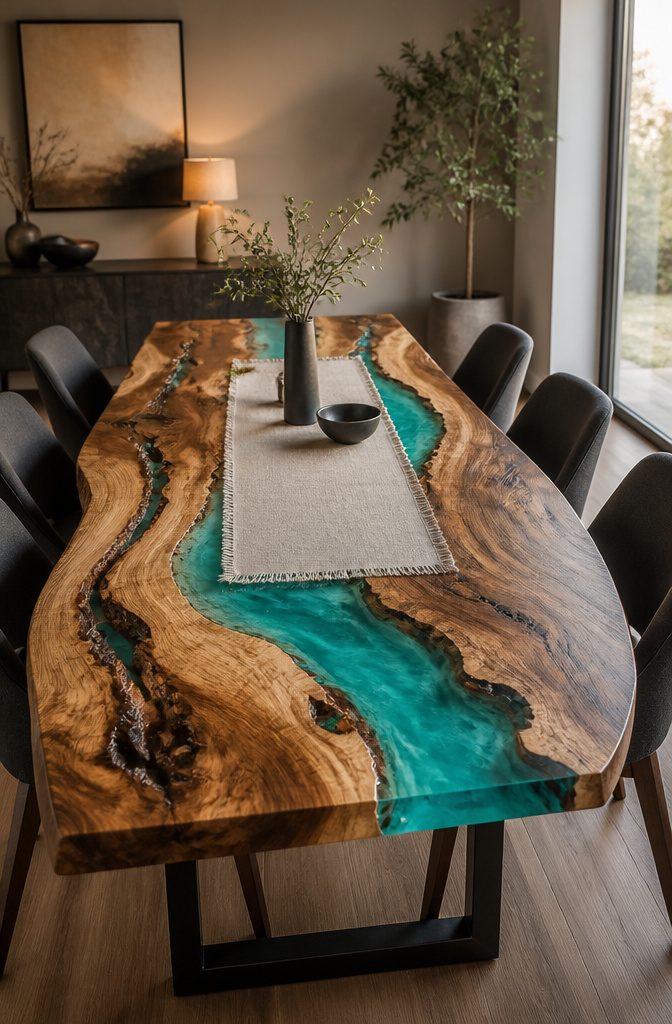
Epoxy resin fills cracks, voids, and natural splits in live edge slabs, turning what would otherwise be flaws into deliberate design features.
The resin pools in the gaps and sets hard, creating smooth, glassy rivers that contrast sharply with the wood grain.
Blue epoxy is the most common accent color, often paired with walnut, maple, or spalted maple to mimic water or give the piece a modern, high-contrast look.
Clear epoxy keeps the focus on the wood itself, filling voids without adding color. I’ve also seen turquoise resin used with pecky cypress, white epoxy with cross-cut oak, and black epoxy paired with maple for a dramatic effect.
The resin catches light differently than wood does, so a crack that might have been hidden becomes the focal point of the table.
9. Metal Legs
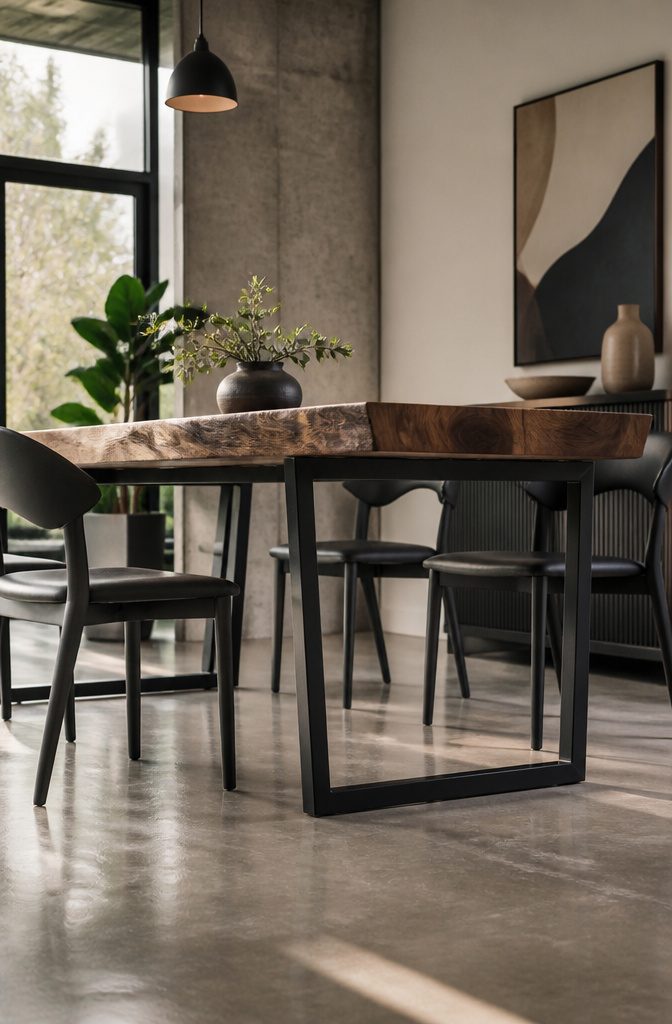
Steel, iron, and powder-coated black bases anchor a live edge slab without competing for attention.
The metal reads industrial, which plays well against the organic edge: you get contrast without clashing. A raw steel frame develops a patchy oxidation over time if left unsealed, and that can look deliberate in the right space.
Powder-coated black stays consistent and hides fingerprints better than bare metal, so I reach for it in homes with kids or heavy use.
The pairing works because the base keeps a tight profile. Hairpin legs or flat bar frames stay out of the way visually, and the wood becomes the feature.
If you lean modern or minimalist, matte black metal under walnut or maple gives you the cleanest read. Farmhouse and boho styles can absorb a heavier iron base, but the slab still carries the look.
10. Wooden Bases
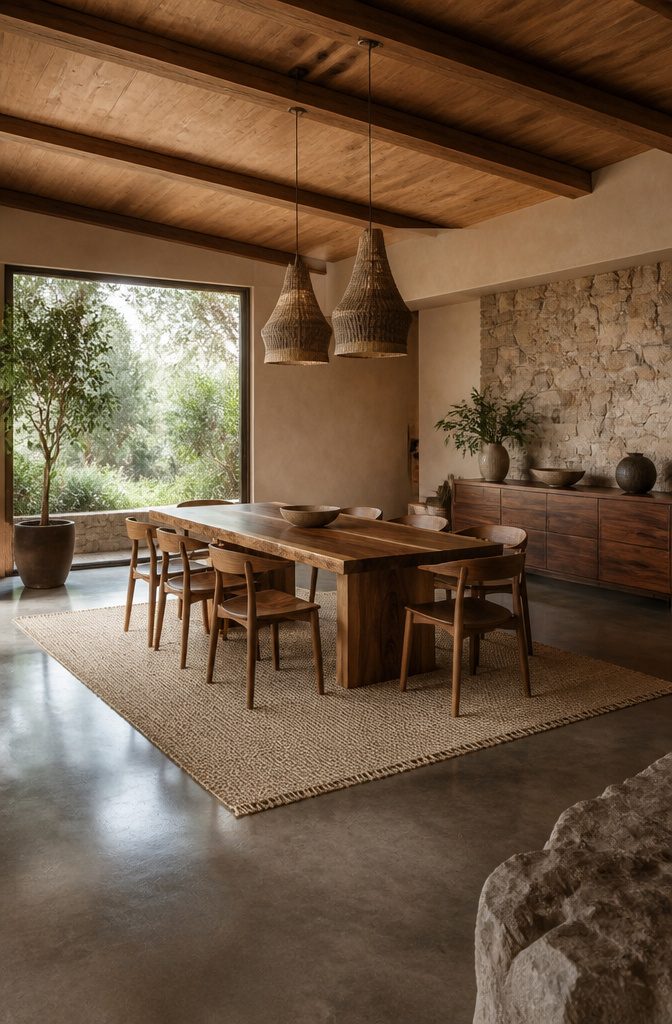
Wooden Bases
A wooden base that matches or complements the slab’s species ties the piece together in a way metal never will. Walnut legs under a walnut top read as one unbroken statement, especially when the grain runs in the same direction.
Oak bases bring that wide, open grain pattern to both the top and the structure below, and the consistency feels deliberate rather than assembled.
Contrast works when the tones sit far enough apart. A creamy white maple base under dark brown walnut gives you definition without fighting the material.
Golden brown acacia legs under a lighter slab add warmth without muddying the palette. Wooden frames handle this better than metal because the texture stays constant even when the color shifts.
Base style matters more with wood than with steel.
A simple four-leg frame in the same species disappears into the design, which is the point. Heavier trestle bases in a contrasting wood become their own feature, so the table needs enough visual weight in the slab to balance it.
Live Edge vs. Traditional Dining Tables
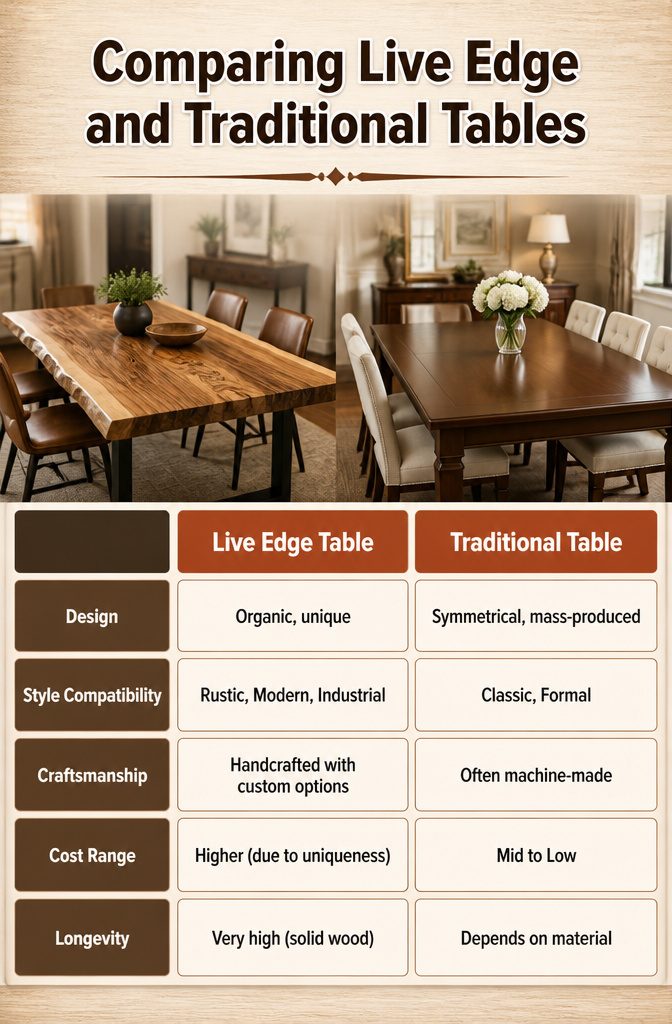
The organic edge is what you’re paying for, and everything else follows from that choice.
A live edge table keeps the natural contour of the tree, wavy bark line and all, while a traditional table gets milled to straight lines and right angles.
The comparison breaks down to five differences that affect what you can pair it with and what you’ll spend.
| Feature | Live Edge Table | Traditional Table |
|---|---|---|
| Design | Organic, unique | Symmetrical, mass-produced |
| Style Compatibility | Rustic, Modern, Industrial | Classic, Formal |
| Craftsmanship | Handcrafted with custom options | Often machine-made |
| Cost Range | Higher (due to uniqueness) | Mid to Low |
| Longevity | Very high (solid wood) | Depends on material |
Live edge wins if you want a centerpiece that reads as one-of-a-kind and you’re comfortable mixing it into mid-century or industrial rooms.
Traditional tables slip into formal dining rooms without a second thought, and the lower price leaves budget for upholstered chairs or a rug.
How These Tables Are Made
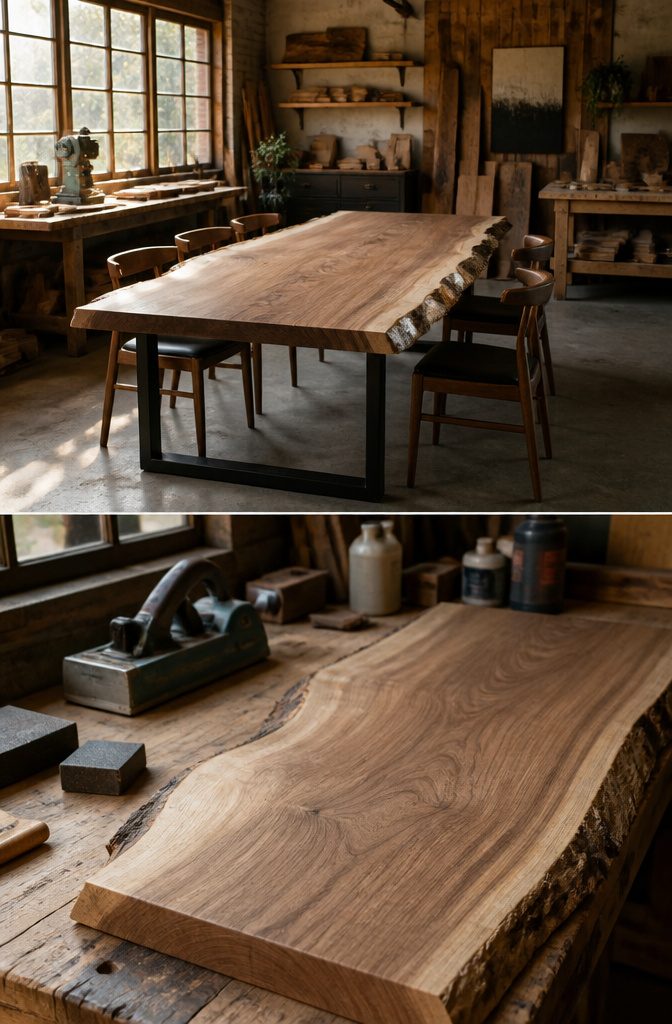
The process starts with selecting a single hardwood slab, usually walnut, oak, or maple, thick enough to handle leveling without losing too much height. Craftsmen remove any loose bark, then flatten the top surface using a router sled or planer.
In one video walkthrough, a builder runs a homemade router sled the full length of a maple slab, taking shallow passes until the surface sits level. The live edge stays untouched through this step.
Once flat, the slab gets sanded smooth, working through progressively finer grits to remove planer marks and bring out the grain.
Any cracks or voids get filled with epoxy resin, both to stabilize the wood and to lock in character. After the resin cures for several days, it’s sanded flush with the surrounding wood.
Sealing comes last, and it decides how much the grain pops. Oil finishes like Rubio Monocoat Pure soak in and bring out natural color with a single coat.
Epoxy or varnish builds a thicker protective layer and adds sheen. The base attaches after sealing, often steel legs or a wooden frame, sometimes set into routed pockets so they sit flush.
Care and Maintenance
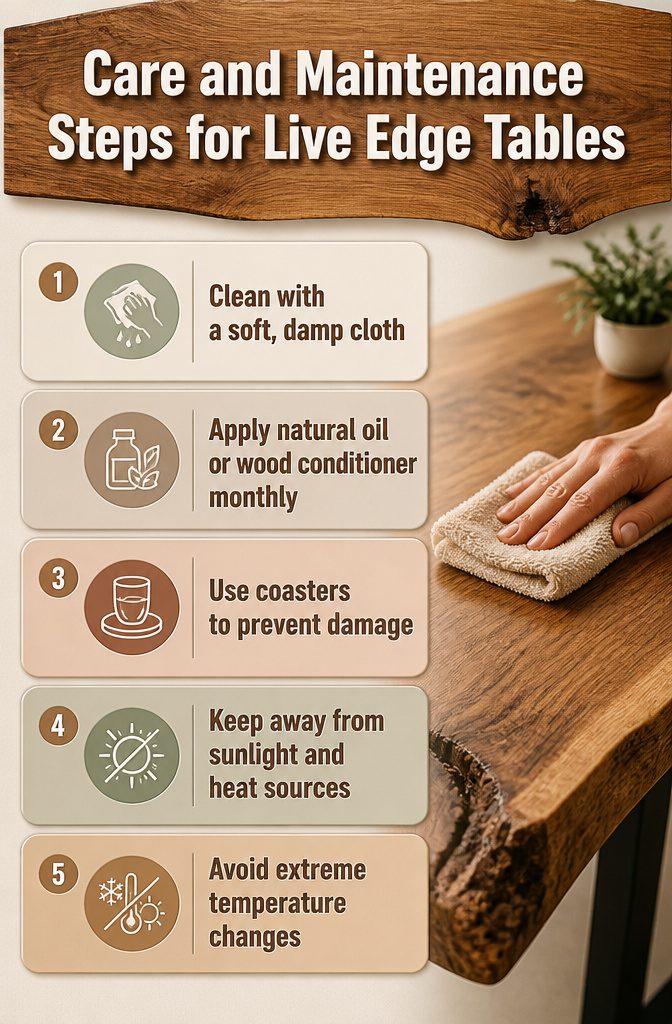
A live edge table stays looking good when you clean it regularly with a soft, damp cloth. Skip harsh chemicals and all-purpose cleaners, both of which can strip the finish or dry out the wood faster than it should.
Apply natural oil or wood conditioner once a month to keep the wood hydrated and prevent cracking.
This is the single most reliable way to protect the slab long term, especially if you live somewhere dry or if the table sits near heating vents.
A few other moves that matter:
- Use coasters. Water rings and heat marks show up fast on natural wood, and they are harder to fix than they are to prevent.
- Keep the table away from direct sunlight and heat sources. Both cause the wood to dry out, fade, or crack over time.
- Avoid extreme temperature changes. Moving a table from a cold garage into a heated room, or placing it near a fireplace, stresses the wood and can open cracks along the grain.
Customization Options
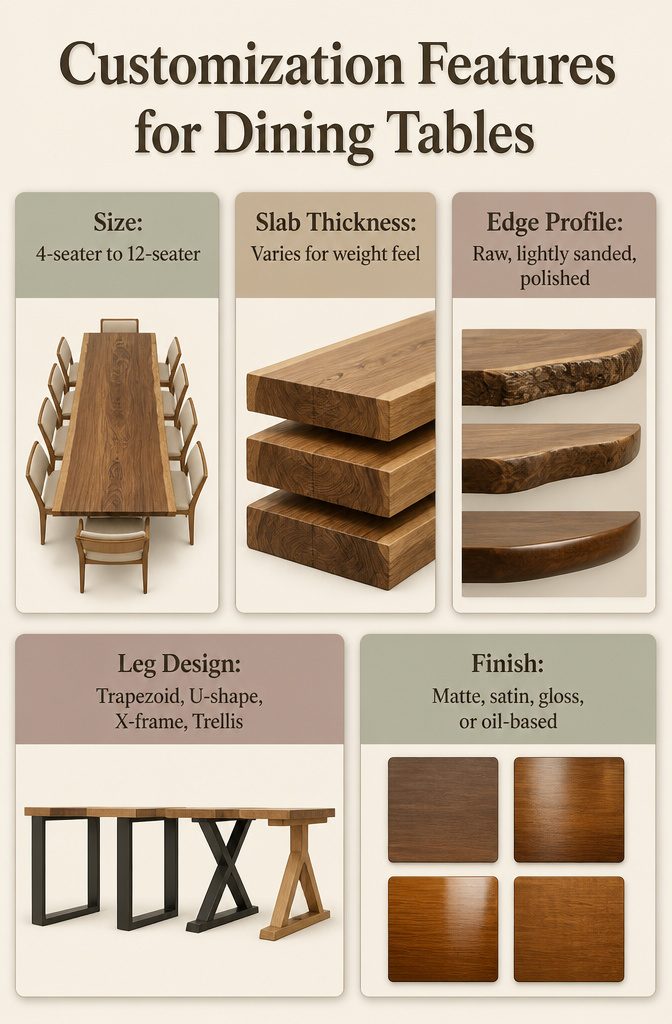
Customization Options
Most makers let you spec the table to the room: size runs from four-seater to twelve-seater, slab thickness changes how heavy the piece feels, and edge profile decides whether you want the bark side raw, lightly sanded, or polished smooth.
Leg design gives you trapezoid, U-shape, X-frame, or trestle, and finish ranges from matte to satin, gloss, or oil-based depending on how much sheen you want and how often you’ll be wiping it down.
I pick size and leg style first because those lock in the footprint and the look, then edge profile to match how formal the room is.
A raw edge reads casual and a polished one works in a dining room that sees linen napkins. Finish comes last, and matte hides fingerprints better than gloss if you have kids at the table.
The whole point of customization is fitting the table to the space instead of making the space work around standard dimensions, and it lets you match the piece to what’s already in the room without settling for close enough.
Where Live Edge Tables Work Best
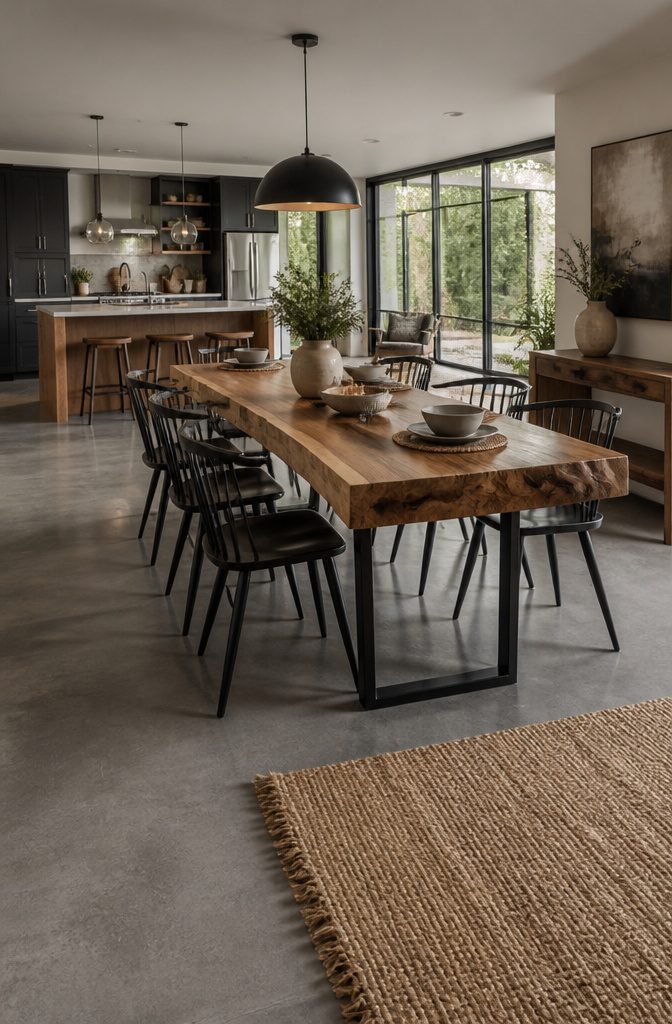
A live edge table reads best in rooms that can handle a visual anchor.
The irregular edge and visible grain carry enough character that the table becomes the focal point wherever it sits, so it needs a setting that lets it breathe.
Dining rooms take the table naturally. The wood grain and natural edge create a centerpiece that pulls attention the moment someone walks in, and the organic silhouette softens the formal symmetry most dining rooms lean on.
Open-concept kitchens benefit from the same anchoring effect. The table bridges the modern kitchen side of the room with the living area, grounding the space without breaking up the sight lines the layout depends on.
Offices and meeting rooms gain warmth from the natural edge without losing the professional tone.
The table reads as substantial and deliberate rather than decorative, which keeps the focus on the work while adding visual interest to what is often a sparse room.
Restaurants and cafés use live edge tables for atmosphere.
The wood texture and one-of-a-kind edge add character that distinguishes the space from chain interiors, and diners on Reddit consistently call out the table as the piece that makes a room feel worth photographing.
Standard Dimensions
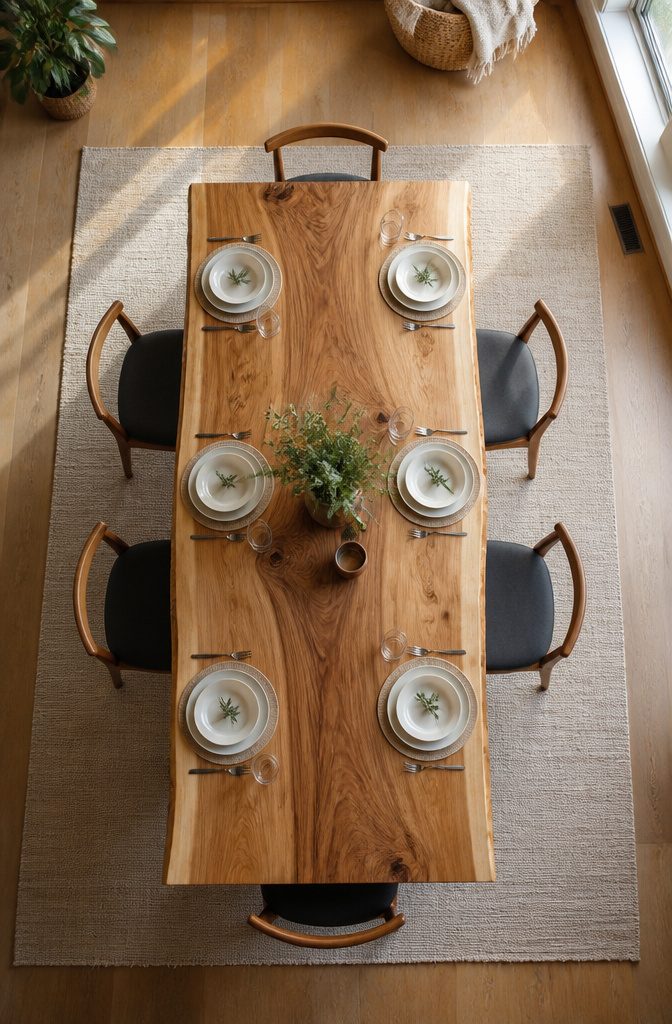
Live edge tables come in four standard widths, and the jump between them matters more than you might expect when you’re trying to seat six versus eight.
- Small (72" × 36" × 30"): Seats four comfortably, six if the conversation is short. Works in a 10′ × 12′ room with clearance for chairs.
- Medium (84" × 40" × 30"): Seats six with elbow room. I’d call this the sweet spot for most dining rooms, leaving at least 36" of walking space on each side in a 12′ × 14′ room.
- Large (94" × 42" × 30"): Seats eight. You need a 14′ × 16′ room to keep this from feeling jammed in.
- X-large (118" × 42" × 30"): Seats ten to twelve. This is open-plan territory, where the table anchors a bigger multi-use space.
All four hold to the standard 30" dining height. If your room is borderline, err smaller: a table you can walk around beats one that fills the square footage.
Frequently Asked Questions
What types of wood are used for live edge dining tables?
Walnut, oak, maple, acacia, and cherry are the most common hardwoods.
Walnut brings deep chocolate-brown grain, oak shows wide open grain patterns, maple offers a pale creamy surface, acacia delivers warm golden tones with darker striations, and cherry starts reddish brown and deepens over time.
How do I maintain my live edge dining table to keep it looking new?
Clean the surface regularly with a soft, damp cloth and apply natural oil or wood conditioner once a month to keep the wood hydrated.
Use coasters to prevent water rings and heat marks, and keep the table away from direct sunlight and heating vents to avoid drying and cracking.
How thick should a live edge table top be?
Slabs need enough thickness to handle leveling without losing too much height during the flattening process.
The final thickness depends on the wood species and the size of the table, but it must be substantial enough to support daily use without warping or flexing.
What kind of chairs go with a live edge table?
Deep green velvet chairs pull out the warm undertones in walnut grain, while upholstered chairs pair well with smoothed edges in formal dining rooms.
The organic silhouette of the table works with both modern metal frames and traditional wooden chairs, depending on whether you want contrast or cohesion.






